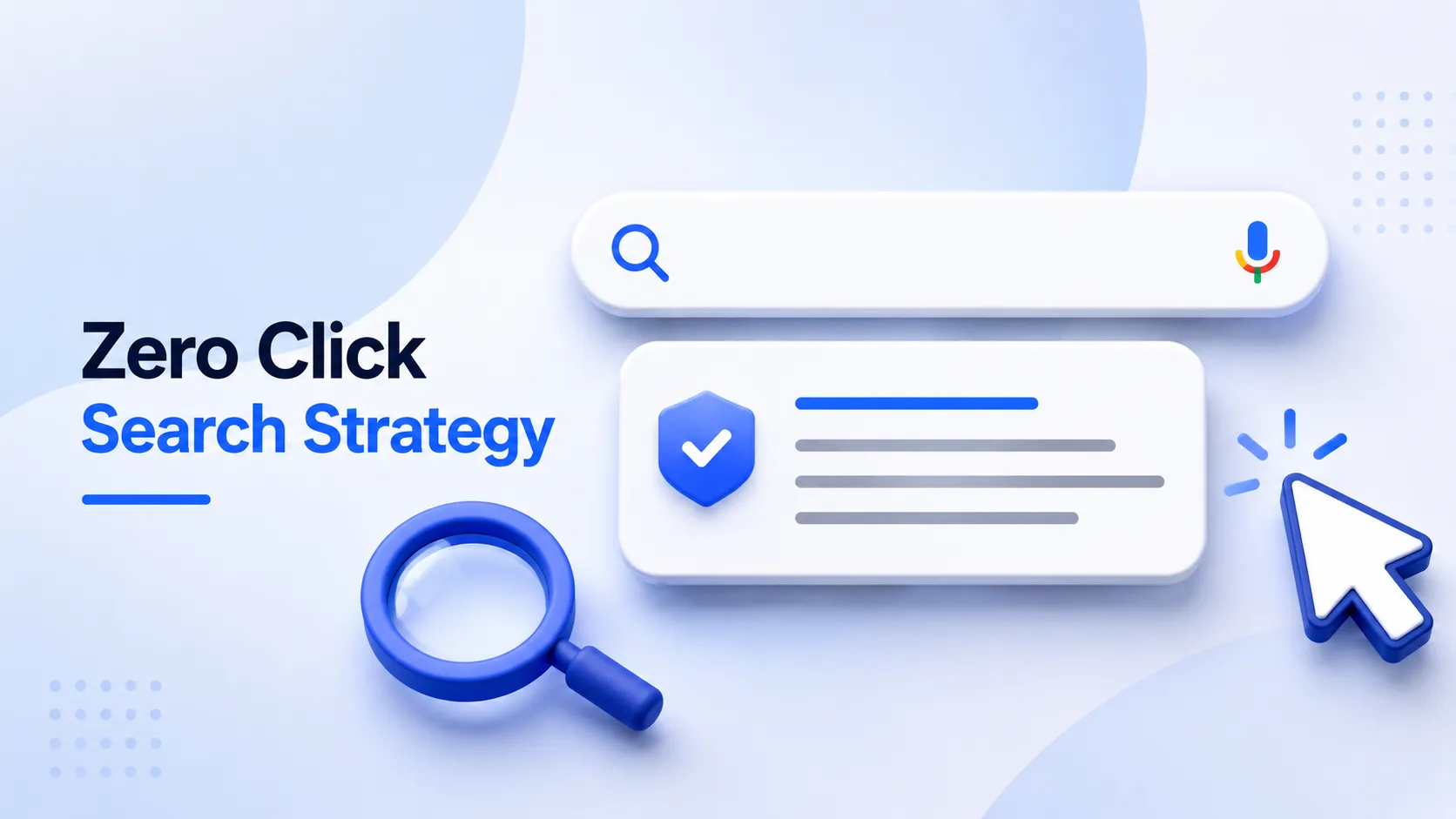
Zero Click Search Strategy: How to Win Traffic Without Clicks
If you have been tracking your organic traffic lately, you may have noticed something strange. Your rankings look solid, but your clicks keep dropping. You are not imagining it.
Welcome to the era of zero click searches.
Google now answers millions of queries directly on the search results page. Users get the information they need without ever visiting a website. This is both a challenge and a huge opportunity — if you know how to play the game.
In this guide, you will learn exactly what a zero click search strategy is, why it matters more than ever in 2026, and how to build one that works for your brand.
What Is a Zero Click Search?
A zero click search happens when a user types a query into Google and gets the answer right there on the results page — without clicking on any link.
These results come in the form of:
- Featured snippets
- Knowledge panels
- People Also Ask (PAA) boxes
- Local packs
- AI Overviews
- Calculators and converters
- Weather and sports results
According to studies, more than 60% of Google searches now end without a single click. That number keeps growing every year.
Why You Still Need a Zero Click Search Strategy
At first, zero click searches sound like bad news. No clicks means no traffic, right?
Not exactly.
A smart zero click search strategy focuses on visibility, not just visits. Here is why that still matters:
| Benefit | How It Helps You |
|---|---|
| Brand awareness | Millions see your brand name even without clicking |
| Authority building | Appearing in snippets signals trust and expertise |
| Voice search wins | Voice assistants pull answers from zero click results |
| Lead generation | Local packs drive calls and foot traffic directly |
| AI Overview presence | Your content gets cited even in AI-generated answers |
The brands that dismiss zero click search are losing visibility to competitors who embrace it.
How Zero Click Searches Have Changed SEO
Traditional SEO was simple. Rank high, get clicks, earn revenue.
Today, the funnel is more layered.
Users might see your brand in a featured snippet today, search your name directly tomorrow, and convert next week. The journey is longer and less linear.
This is why topical authority has become so critical. If Google trusts your site as the go-to resource on a topic, it pulls your content into zero click results consistently. To understand how topical authority works and how to build it, read this detailed guide on what is topical authority in SEO.
Building authority across an entire topic cluster — not just chasing individual keywords — is the foundation of any effective zero click search strategy.
7 Proven Zero Click Search Strategy Tactics
1. Target Featured Snippet Positions
Featured snippets appear at the very top of search results. They steal the click but hand you massive visibility.
To win featured snippets:
- Answer the question clearly in the first 40–60 words
- Use the exact query as a heading (H2 or H3)
- Format answers in lists, tables, or short paragraphs
- Target question-based keywords (what, how, why, when)
Featured snippets are one of the most direct ways to implement a zero click search strategy without sacrificing brand exposure.
2. Dominate the People Also Ask Box
The People Also Ask (PAA) box expands with related questions every time a user clicks one. It is a never-ending opportunity.
How to get into PAA boxes:
- Research PAA questions using tools like AlsoAsked or SEMrush
- Write dedicated FAQ-style content around these questions
- Keep your answers under 50 words — clear and direct
- Structure your content with question-based H3 subheadings
When your content appears across multiple PAA boxes for a topic, you dominate the search results page — even without clicks.
3. Optimize for AI Overviews
Google’s AI Overviews (formerly SGE) have changed how zero click search works. Now, instead of just a snippet, Google generates a full AI-written summary at the top of results — often citing multiple sources.
Getting cited inside AI Overviews is the new SEO gold rush.
The good news? The same practices that earn featured snippets also help you appear in AI Overviews. You need clear, well-structured, factually accurate content that directly answers user intent.
For a deeper breakdown of how to position your content inside these results, check out this complete guide on how to rank in AI overviews.
4. Use Structured Data Markup
Schema markup tells Google exactly what your content is about. It dramatically increases your chances of appearing in rich results.
| Schema Type | Zero Click Result It Targets |
|---|---|
| FAQ Schema | People Also Ask boxes |
| HowTo Schema | Step-by-step rich results |
| Review Schema | Star ratings in results |
| LocalBusiness Schema | Google Maps and local pack |
| Article Schema | News and featured content |
| Product Schema | Shopping results |
Adding schema to your pages is one of the highest-ROI investments in a zero click search strategy.
5. Prioritize Local SEO for Local Pack Results
If you run a local business, zero click search is actually your best friend.
The Google local pack (the map with three business listings) shows up for almost every local query. Users see your name, rating, hours, phone number, and address — and often call or visit without ever clicking your website.
To win the local pack:
- Keep your Google Business Profile fully updated
- Collect consistent five-star reviews
- Add your business to local directories
- Use location-based keywords in your content
- Post regularly on your Google Business Profile
Local zero click results drive real-world actions far better than regular organic clicks.
6. Build a Brand-Search Ecosystem
Here is the long game of zero click search strategy.
When users see your brand repeatedly in featured snippets, PAA boxes, and AI Overviews — even without clicking — they remember you. Over time, they search your brand name directly. That branded traffic is yours to keep.
This is why brand building and SEO are no longer separate activities. Every zero click impression is a brand touchpoint.
Focus on:
- Publishing consistent, high-quality content
- Getting mentioned on other authority websites
- Building a recognizable brand voice and visual identity
- Encouraging social sharing and word of mouth
7. Create Content Specifically for Voice Search
Voice search is almost entirely zero click. When someone asks Alexa or Google Assistant a question, the assistant reads one answer aloud — and no website gets a visit.
But the brand behind that answer gets heard.
To optimize for voice search as part of your zero click search strategy:
- Write in conversational, natural language
- Target long-tail, question-based queries
- Use clear and concise answers (under 30 words when possible)
- Mark up your FAQs with schema
- Focus on local voice queries (“near me” searches)
Measuring Success Without Click Data
One challenge with zero click search strategy is measuring results. If there are no clicks, how do you know it is working?
Here are the right metrics to track:
| Metric | What It Tells You |
|---|---|
| Impressions in Search Console | How often your site appears in results |
| Featured snippet count | Number of queries where you own the snippet |
| Brand search volume | Are more people searching your name? |
| Direct traffic growth | Users who already know your brand |
| Phone calls and map views | For local businesses |
| Share of Voice | Your visibility vs competitors |
Shift your mindset from traffic-first to visibility-first. That is the core of a modern zero click search strategy.
The Role of Content Marketing in Zero Click SEO
You cannot win zero click results with thin content. Google pulls answers from websites it trusts — websites that consistently publish detailed, helpful, and well-structured content.
This is where content marketing becomes inseparable from SEO.
When you invest in building a content engine that covers your topic comprehensively, you naturally start ranking for more snippets, more PAA boxes, and more AI Overview citations.
If you want to learn how to scale this content production efficiently, this guide on how to use AI for content marketing is a great place to start. It shows you how to maintain quality while publishing at scale — a critical advantage in competitive niches.
Common Mistakes to Avoid
A bad zero click search strategy can waste resources. Here are the most common mistakes:
- Chasing snippets for high-volume keywords only — Competition is brutal. Target mid-tail questions where you can realistically win.
- Ignoring schema markup — Skipping structured data leaves ranking opportunities on the table.
- Writing for bots, not humans — Google rewards content that genuinely helps people. Over-optimized, robotic writing does the opposite.
- Forgetting to measure impressions — If you only track clicks, you will miss the real impact of your zero click efforts.
- Treating it as a separate strategy — Zero click SEO should be baked into your overall content and SEO strategy, not siloed.
Frequently Asked Questions
Q1: Does a zero click search strategy hurt my website traffic?
Not necessarily. While individual click-through rates may drop, a well-executed zero click strategy builds brand authority and drives more branded searches over time. It shifts your traffic source, not your total visibility.
Q2: What type of content wins the most zero click results?
Content that directly answers questions — FAQs, how-to guides, definition posts, comparison tables, and step-by-step tutorials — tends to perform best in featured snippets and PAA boxes.
Q3: Is zero click search the same as voice search optimization?
They overlap significantly. Voice search results are almost always zero click results. Optimizing for voice search is a key part of any zero click search strategy, but zero click extends beyond voice to snippets, knowledge panels, and local packs.
Q4: How long does it take to see results from a zero click search strategy?
Typically, you can start winning featured snippets within 4–12 weeks of publishing well-optimized content. AI Overview citations may take longer as Google evaluates your site’s authority and trustworthiness.
Q5: Should small businesses invest in a zero click search strategy?
Absolutely. For local businesses especially, zero click results like Google’s local pack drive phone calls, directions requests, and walk-in visits without needing a website click at all.
Q6: Can I use schema markup on any website platform?
Yes. Whether you use WordPress, Shopify, Wix, or a custom-built site, you can implement schema markup. On WordPress, plugins like Rank Math make it easy to add structured data without touching code.
Conclusion
Zero click searches are not the end of SEO. They are the next evolution of it.
The brands that adapt — those that think beyond the click and focus on visibility, authority, and user intent — will dominate search results pages for years to come.
A winning zero click search strategy is built on strong content, structured data, topical authority, and a clear understanding of how Google now serves information. Start with one tactic, measure your impressions, and build from there.
The brands winning zero click searches today are simply the ones who started their strategy yesterday. It is not too late to begin.