What Is Topical Authority in SEO And How to Build It
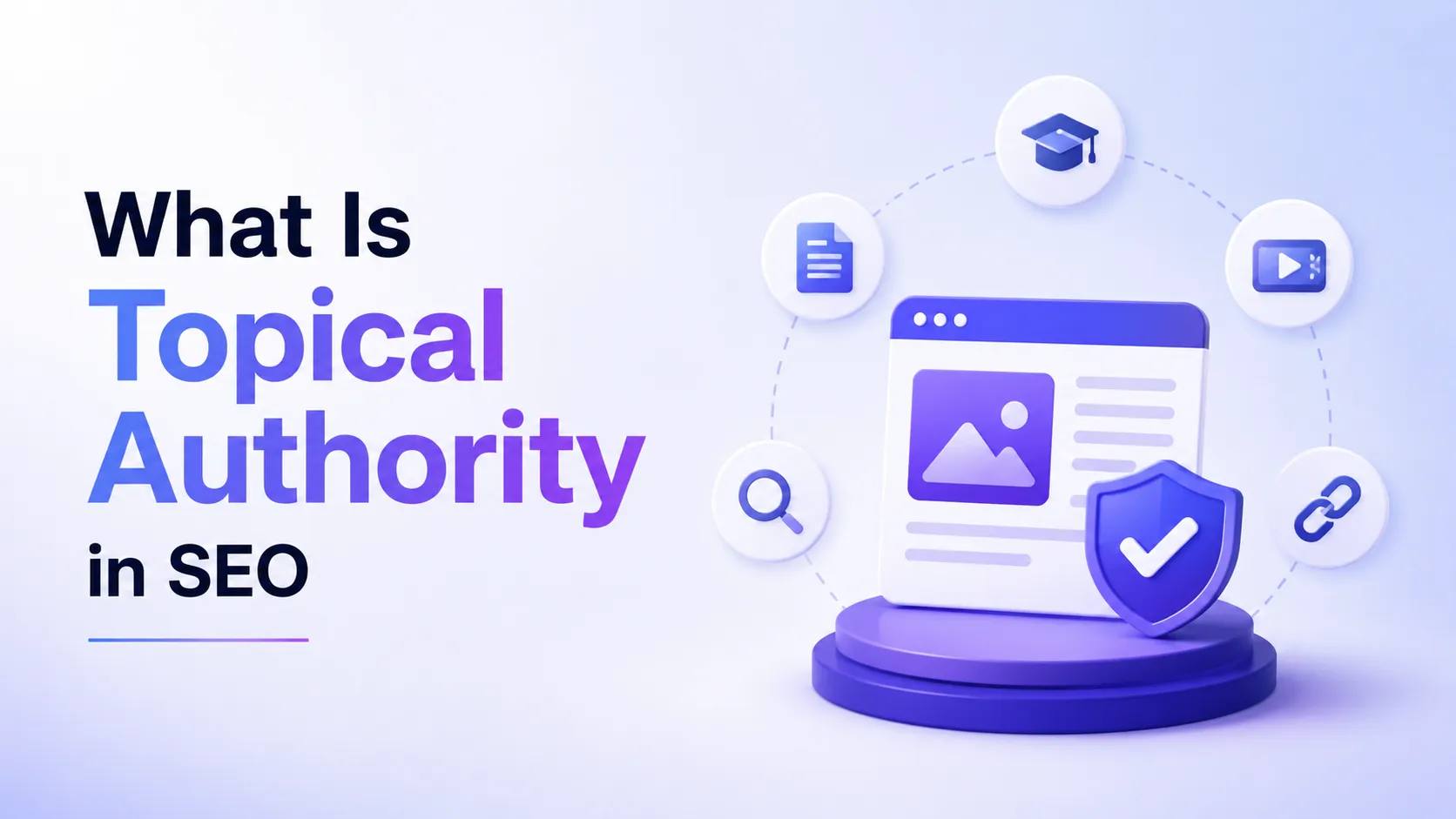
If you have been struggling to rank your blog posts — even after doing everything “right” — topical authority might be the missing piece.
Google no longer just rewards individual articles. It rewards websites that prove they know their subject inside out.
In this guide, you will learn exactly what is topical authority in SEO, why it is now a core ranking factor, and how you can build it from scratch — even on a new website.
Let us get straight into it.
What Is Topical Authority in SEO?
Topical authority in SEO refers to the level of expertise and trustworthiness a website demonstrates on a specific subject area.
When your website covers a topic deeply and comprehensively, Google begins to see it as a go-to resource for that subject. This signals authority — and authority drives rankings.
Think of it this way.
If you search for “how to treat a sprained ankle,” you are more likely to trust a sports medicine website than a general lifestyle blog. Google thinks the same way.
Building topical authority means convincing Google that your website is the most reliable source on your chosen topic.
Why Topical Authority Matters More Than Ever in 2025
Google’s algorithms have evolved significantly. With the Helpful Content Update and the rise of AI-generated content, Google now focuses heavily on E-E-A-T — Experience, Expertise, Authoritativeness, and Trustworthiness.
Topical authority directly supports all four of these pillars.
Here is why it matters so much right now:
- Google is penalizing thin, scattered content
- AI-generated content floods every niche daily
- Users trust in-depth, well-connected content hubs
- Topical sites outrank single-page optimizations over time
Simply put — if you understand what is topical authority in SEO and build it properly, you gain a long-term competitive edge.
Topical Authority vs. Domain Authority: What Is the Difference?
Many people confuse these two. They are related — but not the same.
| Factor | Topical Authority | Domain Authority |
|---|---|---|
| Definition | Depth of expertise on a specific subject | Overall strength of a domain based on backlinks |
| Measured by | Content coverage and relevance | Third-party tools (Moz, Ahrefs) |
| Built through | Content clusters and internal linking | Link building and brand mentions |
| Google’s use | Direct ranking signal | Indirect influence |
| Timeline | Can grow faster with strategic content | Grows slowly over time |
Domain authority is largely a third-party metric. Topical authority is what Google actually evaluates when deciding which page deserves to rank.
How Google Measures Topical Authority
Google does not have a single “topical authority score.” Instead, it evaluates several signals together.
1. Content Coverage
Does your site cover a topic from every angle?
If you write about “keto diet” but only have three articles, Google sees gaps. A site with 40 well-linked keto articles — beginner guides, meal plans, recipes, science breakdowns — clearly demonstrates deeper authority.
2. Semantic Relevance
Google’s natural language processing (NLP) can understand context and meaning. It knows which topics are related.
Your content should naturally include related terms, concepts, and questions — not just your primary keyword stuffed repeatedly.
3. Internal Linking Structure
How your pages connect matters a lot. Strong internal linking signals to Google that your content is related and organized. It also helps crawlers discover and index all your pages faster.
4. User Engagement Signals
If users land on your site and keep reading — clicking to other articles, spending time on pages — Google takes note. Engaged readers are a strong sign of authoritative, helpful content.
5. Backlink Quality From Niche Sources
Getting links from authoritative websites in the same niche signals credibility. A fitness website linking to your fitness blog matters more than a random news site.
How to Build Topical Authority in SEO: Step-by-Step
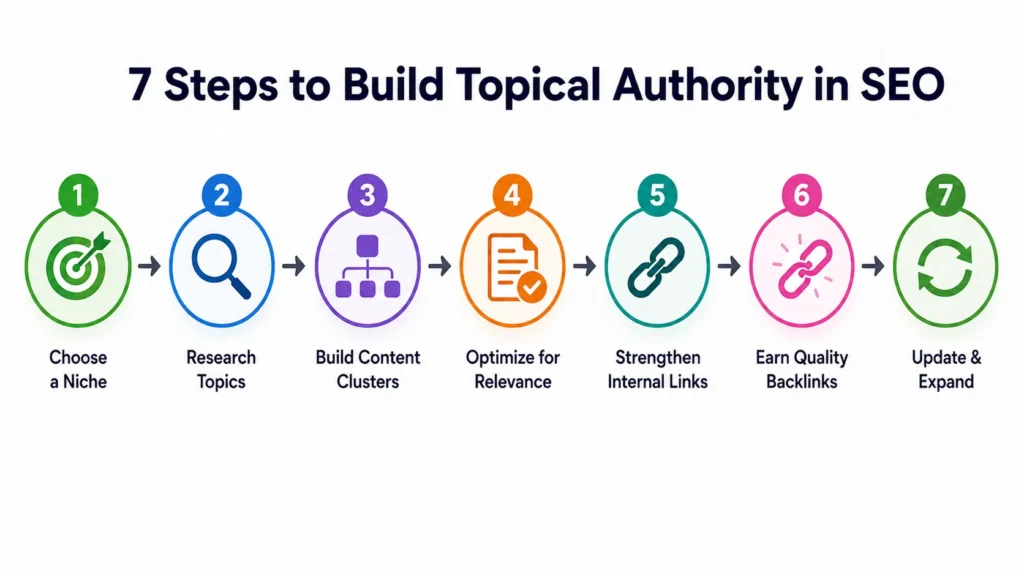
Now that you know what is topical authority in SEO, let us talk about how to actually build it.
Step 1 — Choose a Clear Niche (And Stick to It)
The biggest mistake bloggers make is writing about everything.
Pick one focused niche. The narrower you go at the start, the faster you build authority.
For example, instead of “health and wellness,” start with “gut health for women over 40.” Own that space first. Then expand.
Step 2 — Conduct Thorough Topic Research
Before writing a single word, map out every subtopic your niche contains.
Use tools like:
- Ahrefs or Semrush — for keyword clustering
- Google’s People Also Ask — to find real user questions
- Reddit and Quora — to spot what your audience actually struggles with
- AlsoAsked.com — for question mapping
Your goal is to create a complete topic map — a bird’s-eye view of everything your audience needs to know.
Step 3 — Build Content Clusters (Pillar + Supporting Pages)
This is the backbone of topical authority building.
A content cluster works like this:
| Page Type | Purpose | Example |
|---|---|---|
| Pillar Page | Broad, comprehensive guide on main topic | “Complete Guide to Intermittent Fasting” |
| Cluster Page | Deep dive into subtopic | “Intermittent Fasting for Women Over 50” |
| Cluster Page | Deep dive into subtopic | “Intermittent Fasting and Workout Timing” |
| Cluster Page | Deep dive into subtopic | “What to Eat During Intermittent Fasting” |
| Cluster Page | Deep dive into subtopic | “Common Intermittent Fasting Mistakes” |
All cluster pages link back to the pillar. The pillar links to all clusters. This creates a web of relevance that Google clearly understands.
Step 4 — Optimize Each Article for Semantic SEO
Topical authority is not just about quantity — it is about depth and relevance.
For each article, make sure you:
- Cover the topic fully (do not leave obvious questions unanswered)
- Include related terms and synonyms naturally
- Answer the search intent precisely
- Use clear headings that reflect real user questions
- Add data, examples, and original insight where possible
Step 5 — Build a Strong Internal Linking System
Every new article you publish should link to and from relevant existing articles.
Think of your website as a city. Internal links are the roads. Without roads, even great content sits isolated and undiscovered.
A good rule: every article should have at least 3–5 internal links going to and coming from it.
Step 6 — Earn Niche-Relevant Backlinks
Backlinks still matter — especially from topically relevant sources.
Focus on:
- Guest posts on niche blogs
- Being quoted as an expert (HARO / Connectively)
- Creating linkable assets (original data, infographics, tools)
- Building relationships with other creators in your space
One strong niche backlink beats ten random links from unrelated sites.
Step 7 — Update and Expand Existing Content
Topical authority is not built once and forgotten.
Set a schedule to revisit older articles. Update outdated information, expand thin sections, add new examples, and improve internal links. Fresh, maintained content signals that your site is actively managed and trustworthy.
Common Mistakes That Kill Topical Authority
Even well-intentioned SEOs make these errors. Avoid them.
| Mistake | Why It Hurts |
|---|---|
| Writing on random unrelated topics | Confuses Google about your site’s focus |
| Thin content with no depth | Fails to cover the topic comprehensively |
| Ignoring internal linking | Leaves content isolated and disconnected |
| Targeting only high-volume keywords | Misses the semantic coverage Google values |
| Publishing and forgetting | Stale content loses trust over time |
| Copying competitor structures blindly | Lacks original perspective and value |
Tools to Help You Build Topical Authority
You do not have to do this alone. These tools make the process faster and smarter.
| Tool | Best For |
|---|---|
| Ahrefs | Keyword clustering, competitor content gaps |
| Semrush | Topic research, content audit |
| Surfer SEO | On-page semantic optimization |
| Rank Math SEO | On-page optimization and internal link suggestions |
| AlsoAsked | Mapping user questions visually |
| Clearscope | Content grading for topical relevance |
Rank Math’s Content AI feature, in particular, is excellent for checking whether your article covers a topic with enough semantic depth.
How Long Does It Take to Build Topical Authority?
There is no fixed timeline — but here is a realistic picture.
| Stage | Timeline | What to Expect |
|---|---|---|
| Early Stage | 0–3 months | Little traffic; Google crawling and indexing |
| Growth Stage | 3–6 months | Rankings begin appearing for lower competition keywords |
| Authority Stage | 6–12 months | Consistent traffic, ranking for competitive terms |
| Established Authority | 12+ months | Passive rankings, organic backlinks, brand recognition |
The key is consistency. Sites that publish strategically and regularly build authority significantly faster than those that post sporadically.
Frequently Asked Questions
What is topical authority in SEO in simple terms?
Topical authority in SEO means that your website is recognized by Google as a trusted, in-depth source on a specific subject. The more thoroughly you cover a topic, the more authority you build — and the easier it becomes to rank.
Is topical authority more important than backlinks?
Both matter, but topical authority is increasingly becoming a primary ranking signal. A site with strong topical authority and fewer backlinks can outrank a site with more links but scattered, shallow content.
How many articles do I need to build topical authority?
There is no magic number. It depends on your niche’s complexity. Some niches need 20–30 well-structured articles. Others may require 100+. Focus on covering your topic comprehensively rather than hitting a specific count.
Can a new website build topical authority?
Yes — and actually, new websites benefit most from a topical authority strategy. Instead of competing broadly, you build deep expertise in one area first. This gives you a clear path to early rankings while larger sites ignore niche subtopics.
Does Rank Math help with topical authority?
Rank Math helps you optimize individual articles for on-page SEO, semantic keywords, and internal linking — all of which contribute directly to building topical authority over time. Combined with a solid content cluster strategy, it is a powerful workflow.
What is the difference between topical authority and keyword authority?
Keyword authority refers to ranking strength for a single term. Topical authority is broader — it is about dominating an entire subject area across multiple keywords and content pieces. Topical authority naturally improves keyword authority over time.
Conclusion
Understanding what is topical authority in SEO is one of the most valuable shifts you can make in your content strategy.
Google has moved well beyond rewarding isolated articles optimized for single keywords. Today, it rewards websites that act like genuine experts — covering their subject thoroughly, connecting content logically, and delivering real value to readers.
The good news? Topical authority is achievable for anyone willing to be strategic and consistent.
Start by choosing your niche. Map out your topics. Build your content clusters. Strengthen your internal links. And keep improving what you publish.
Over time, Google will take notice — and your rankings will reflect it.
The path to ranking dominance in 2026 runs directly through topical authority. Now you know exactly how to walk it.