What Is Keyword Difficulty? & How To Measure It
If you have ever done keyword research, you have probably come across a score called “keyword difficulty.” But what exactly does it mean? And should it really influence the keywords you target?
In this guide, you will learn what is keyword difficulty, how it is calculated, and how to use it smartly to grow your website’s organic traffic.
Let’s break it down.
What Is Keyword Difficulty?
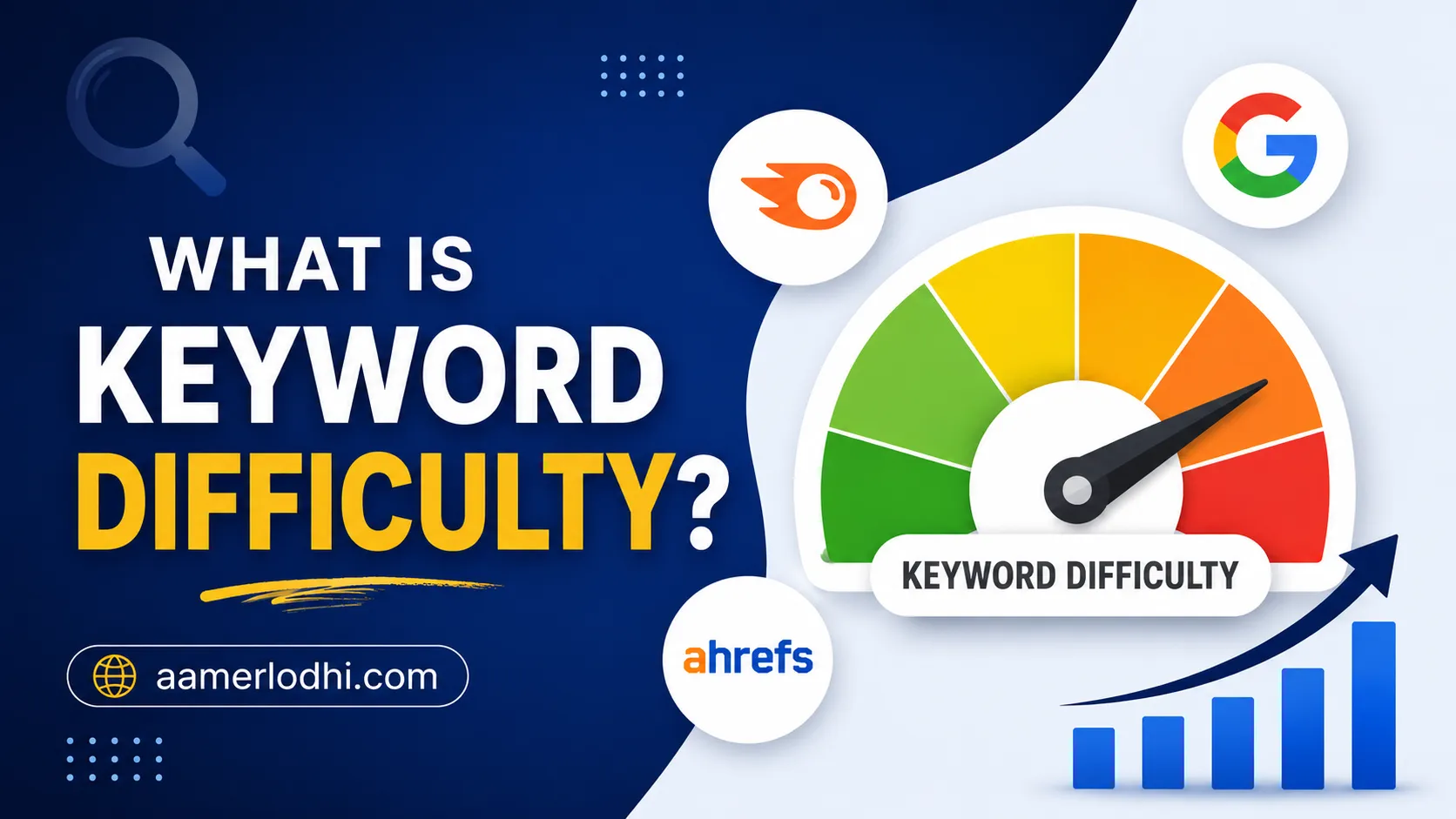
Keyword difficulty (KD) is an SEO metric that tells you how hard it will be to rank on the first page of Google for a specific keyword.
It is usually shown as a number between 0 and 100. The higher the number, the more competitive the keyword is. A score of 80 means it is extremely hard to rank. A score of 10 means you have a decent shot.
Most SEO tools, including Ahrefs, Semrush, Moz, and Ubersuggest, calculate keyword difficulty in their own way. But the core idea remains the same across all of them.
Simply put: keyword difficulty tells you the level of competition you are up against.
Why Keyword Difficulty Matters in SEO
Understanding keyword difficulty is not just about avoiding hard keywords. It is about working smarter with your resources.
Here is why it matters:
If you are a new website with low domain authority, going after a keyword with a KD of 85 is a waste of time and effort. You are unlikely to rank, no matter how good your content is.
On the other hand, targeting low-difficulty keywords gives you a real chance to show up on the first page. Even a small website can compete if it picks the right battles.
Keyword difficulty helps you:
- Prioritize keywords that match your current authority level
- Avoid wasting content efforts on impossible targets
- Build traffic gradually and scale over time
Once you understand this concept, it becomes one of the most valuable parts of your keyword research process. And if you want to make the most of your content, you should also know how to optimize your blog posts for SEO to ensure every piece you publish is working at its full potential.
How Is Keyword Difficulty Calculated?
Different tools use slightly different formulas. But most of them look at the same core signals.
Here are the main factors that determine keyword difficulty:
1. Backlink Profile of Top-Ranking Pages The more high-quality backlinks the top 10 results have, the harder it is to outrank them.
2. Domain Authority of Competing Sites If Forbes, HubSpot, and Healthline are all ranking for a keyword, it signals a highly competitive space.
3. Content Quality and Relevance Well-structured, comprehensive content from authoritative sources is harder to beat.
4. On-Page Optimization Pages that are perfectly optimized for a keyword signal strong competition.
5. Search Intent Match If all top results match user intent perfectly, squeezing in becomes harder.
Some tools also factor in click-through rate data, SERP features like featured snippets, and the number of referring domains.
Keyword Difficulty Score: What Do the Numbers Mean?
Most tools display KD as a percentage or a score out of 100. Here is a general breakdown:
| KD Score | Difficulty Level | Who Should Target It |
|---|---|---|
| 0 – 14 | Very Easy | New websites, beginner bloggers |
| 15 – 29 | Easy | Sites with some content and few backlinks |
| 30 – 49 | Medium | Established sites with moderate authority |
| 50 – 69 | Hard | Sites with strong domain authority |
| 70 – 84 | Very Hard | High-authority websites only |
| 85 – 100 | Super Hard | Industry leaders and mega brands |
Keep in mind that these ranges can vary slightly depending on the tool you use. Ahrefs tends to score higher than Ubersuggest, for example. Always compare your own site’s authority against the top results when interpreting a KD score.
How to Check Keyword Difficulty
You do not need to guess. There are several tools that show you the keyword difficulty score instantly.
Popular SEO Tools for Checking KD:
| Tool | Free Plan Available | KD Score Range |
|---|---|---|
| Ahrefs | Limited (free keyword generator) | 0 – 100 |
| Semrush | Yes (10 queries/day) | 0 – 100 |
| Moz Keyword Explorer | Yes (limited) | 0 – 100 |
| Ubersuggest | Yes (limited) | 0 – 100 |
| Google Keyword Planner | Yes (free) | Low / Medium / High |
For most bloggers and small business owners, Ubersuggest or the free version of Ahrefs is a great starting point.
Here is a simple process to check keyword difficulty:
- Open your chosen SEO tool
- Enter your target keyword in the search bar
- Look at the KD or Keyword Difficulty column
- Compare the score against your site’s current domain authority
- Decide whether to target, skip, or modify the keyword
It really is that straightforward.
What Is a Good Keyword Difficulty Score to Target?
This depends entirely on your website’s age and authority.
For new websites (DA 0–20): Stick to KD scores below 20. Focus on very specific, long-tail keywords. These have lower search volume but are far easier to rank for.
For growing websites (DA 20–40): You can start targeting keywords in the 20–40 KD range. Look for medium-competition keywords with decent monthly search volume.
For established websites (DA 40+): You can go after keywords in the 40–60 range and slowly build toward harder targets.
There is no universal “good” KD. It is always relative to your site’s current strength.
A smart strategy is to build topical authority in SEO by covering a subject deeply before targeting its most competitive keywords. This signals to Google that you are a trusted source on the topic.
Low vs. High Keyword Difficulty: Which Should You Target?
Both have their place in a solid SEO strategy. The key is balance.
Low Keyword Difficulty Keywords:
- Easier and faster to rank for
- Usually long-tail (3–5 words or more)
- Lower search volume
- But — they convert better because they are more specific
High Keyword Difficulty Keywords:
- Take months or years to rank for
- Require strong backlink profiles
- Higher search volume
- Drive massive traffic if you do rank
A balanced content strategy targets low-difficulty keywords first to build authority, then works toward harder keywords over time.
Think of it as climbing a ladder — you start at the bottom and work your way up.
Tips to Rank for Competitive Keywords
Sometimes you have to go after a harder keyword. Here are a few ways to improve your chances:
1. Build Topical Coverage Do not just write one post on a topic. Build out a cluster of related content that proves your expertise.
2. Earn Quality Backlinks Links from relevant, authoritative sites carry weight. Focus on link building through guest posts, PR, and digital partnerships.
3. Match Search Intent Precisely Study the top 10 results for your target keyword. What format do they use? What questions do they answer? Mirror that intent in your own content.
4. Improve Your Page Experience Fast loading speed, mobile-friendliness, and easy navigation all contribute to better rankings.
5. Keep Content Updated Freshness is a ranking signal. Revisit older posts and update them regularly.
Also, in 2025, it is worth knowing how to rank in AI Overviews since Google’s AI-generated results are now appearing above traditional organic listings for many competitive keywords.
Common Keyword Difficulty Mistakes to Avoid
Even experienced SEOs make these mistakes. Watch out for them.
Chasing only high-volume, high-KD keywords High volume is attractive, but if you cannot rank, the traffic means nothing.
Ignoring KD completely Some people just write content without checking competition at all. This is a missed opportunity to prioritize strategically.
Trusting one tool blindly Every tool calculates KD differently. Cross-check two or three tools before making a decision.
Not considering search intent A keyword may have a low KD but if your content does not match what users are looking for, you still will not rank.
Giving up too quickly SEO takes time. Even low-difficulty keywords can take a few months to rank. Patience is part of the strategy.
Frequently Asked Questions
Q1: What is keyword difficulty in simple terms?
Keyword difficulty is a score that tells you how hard it is to rank on Google’s first page for a specific keyword. The higher the score, the more competitive the keyword.
Q2: What keyword difficulty score should a beginner target?
Beginners should focus on keywords with a KD score of 0 to 20. These are less competitive and give new websites a real chance to rank.
Q3: Is keyword difficulty the only factor I should consider?
No. You should also look at search volume, search intent, and how well the keyword relates to your content. KD is just one piece of the puzzle.
Q4: Do all SEO tools calculate keyword difficulty the same way?
No. Ahrefs, Semrush, Moz, and Ubersuggest each use their own algorithm. The scores may differ, so it is smart to check more than one tool.
Q5: Can I rank for a high keyword difficulty keyword without backlinks?
It is very unlikely. High-difficulty keywords almost always require a strong backlink profile and high domain authority. That said, exceptional content matching search intent perfectly can sometimes break through.
Q6: How long does it take to rank for a low-difficulty keyword?
With good on-page SEO and some internal linking, low-difficulty keywords can rank within a few weeks to three months. Results vary depending on your site’s authority.
Q7: Is keyword difficulty the same as keyword competition?
They are related but not identical. Keyword competition in Google Keyword Planner refers to paid ad competition. Keyword difficulty refers specifically to organic search ranking competition.
Conclusion
Understanding what is keyword difficulty is one of the most practical skills you can develop as an SEO practitioner or content creator.
It saves you from wasting months of effort on keywords you cannot realistically rank for. And it opens your eyes to the goldmine of low-competition keywords that are just waiting to be claimed.
Start with what matches your current authority. Build content, earn backlinks, grow your topical credibility, and gradually move up toward harder keywords over time.
SEO is not a sprint. It is a strategic, long-term game — and keyword difficulty is one of the most reliable compasses you have.