
How to Rank in AI Overviews: The Complete Guide
AI is changing how people find information online. Google’s AI Overviews now appear at the very top of search results, pushing traditional blue links further down the page.
If your content is not showing up in these AI-generated summaries, you are losing a massive chunk of organic traffic. Learning how to rank in AI overviews is no longer optional. It is now one of the most important SEO skills you can develop.
This guide will walk you through every step. Let’s get into it.
What Are Google AI Overviews?
Google AI Overviews (formerly known as Search Generative Experience or SGE) are AI-generated summaries that appear at the top of search results pages.
They pull information from multiple trusted sources and present a compact, ready-to-read answer directly in the search results.
Here is what makes them different from traditional featured snippets:
| Feature | Traditional Snippet | AI Overview |
|---|---|---|
| Source | Single webpage | Multiple webpages |
| Format | Direct quote or list | AI-generated summary |
| Links shown | 1 source | 3–8 sources |
| Position | Top of results | Above all results |
| Query types | Specific queries | Broad + complex queries |
Understanding this difference is the first step toward figuring out how to rank in AI overviews.
Why AI Overview Rankings Matter for Your Blog
You might be wondering — does it really make a difference?
Yes. A big one.
When your website is cited inside an AI Overview, users see your brand name, your URL, and a direct link to your content — even before they scroll. That kind of exposure builds trust fast.
Here’s why you should care right now:
- AI Overviews now appear in over 50% of searches across categories
- Sites cited in AI Overviews see a significant boost in branded search traffic
- Being featured signals to Google that your content is authoritative and trustworthy
- Competitors who figure this out first will dominate their niche
The window to gain an early advantage is still open. But it will not stay open forever.
How Does Google Choose Content for AI Overviews?
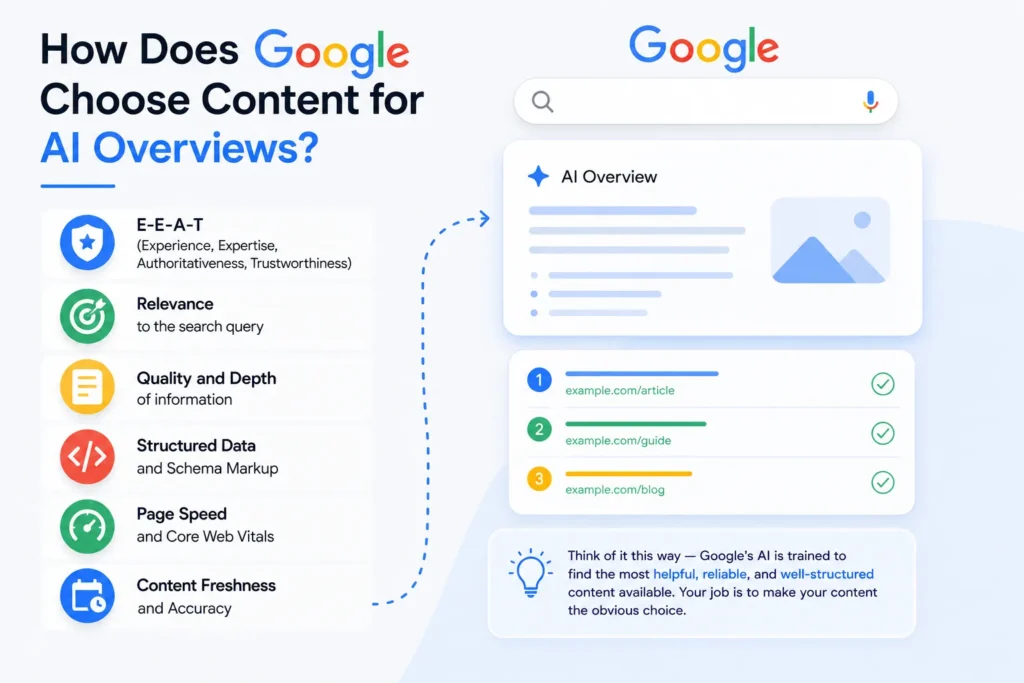
Google’s AI does not pick content randomly. It follows a clear set of signals to decide which pages deserve to be cited.
These signals include:
- E-E-A-T (Experience, Expertise, Authoritativeness, Trustworthiness)
- Relevance to the search query
- Quality and depth of information
- Structured data and schema markup
- Page speed and Core Web Vitals
- Content freshness and accuracy
Think of it this way — Google’s AI is trained to find the most helpful, reliable, and well-structured content available. Your job is to make sure your pages check every single one of those boxes.
How to Rank in AI Overviews: 9 Proven Strategies
Now let us get to the part you are here for. These are the strategies that actually work.
1. Build Strong E-E-A-T Signals
E-E-A-T stands for Experience, Expertise, Authoritativeness, and Trustworthiness. Google’s AI puts heavy weight on this framework when selecting sources for overviews.
Here is how to strengthen each signal:
- Experience: Share first-hand knowledge. Write from personal experience where possible.
- Expertise: Include author bios with credentials. Link to your professional profiles.
- Authoritativeness: Get mentioned or cited by reputable websites in your niche.
- Trustworthiness: Use HTTPS. Display clear contact information. Cite your sources.
If your site feels anonymous or thin on credibility, Google’s AI will skip it.
2. Optimize for Question-Based and Conversational Queries
AI Overviews are triggered most often by questions, comparisons, and “how-to” searches.
Your content should directly answer these types of queries.
Examples of AI Overview-triggering queries:
- “How to rank in AI overviews for beginners”
- “What is the best way to get featured in Google AI results”
- “Why is my website not showing in AI summaries”
Use tools like Google’s “People Also Ask,” AnswerThePublic, or AlsoAsked to find the exact questions your audience is searching for.
Then build content around those questions.
3. Write Clear, Direct Answers Early in Your Content
Google’s AI scans your page for direct answers. It does not want to dig through five paragraphs of fluff before finding your point.
Follow this simple rule: Answer the question within the first 100 words of each section.
Then expand with supporting details, examples, and data.
This is also known as the “inverted pyramid” writing style — most important information first, supporting details after.
4. Use Structured Data and Schema Markup
Schema markup tells Google’s crawlers exactly what your content is about.
For AI Overview optimization, focus on these schema types:
| Schema Type | Use Case |
|---|---|
| FAQPage | FAQ sections at the end of posts |
| HowTo | Step-by-step tutorial content |
| Article | Blog posts and news articles |
| Person | Author bios and credentials |
| BreadcrumbList | Site navigation structure |
Adding schema markup is one of the clearest signals you can send to Google that your content is organized, trustworthy, and worthy of citation. Rank Math makes this easy — just enable the relevant schema type in the post settings panel.
5. Build Deep Topical Authority
Google’s AI does not just look at a single page. It evaluates your entire website’s authority on a topic.
If you write about SEO, you should cover every related sub-topic thoroughly:
- Keyword research guides
- On-page optimization tips
- Link building strategies
- Technical SEO checklists
- AI-specific SEO tactics
This is called topical authority. The more completely you cover a subject, the more Google trusts you as a reliable source for AI Overviews.
Create content clusters — a main pillar page surrounded by supporting posts that link back to each other.
6. Keep Paragraphs Short and Formatting Clean
AI systems parse content more efficiently when it is well-formatted.
Short paragraphs. Clear headings. Bullet points where appropriate.
Here is a quick formatting checklist:
- ✅ Use H2 for main sections, H3 for sub-sections
- ✅ Keep paragraphs to 2–3 sentences max
- ✅ Use bullet points for lists of 3 or more items
- ✅ Bold key terms and important phrases
- ✅ Use tables for comparisons and data
- ✅ Add alt text to all images
Clean formatting also improves your Rank Math readability score — which directly impacts your overall SEO rating.
7. Focus on Long-Tail and Semantic Keywords
Short keywords are competitive. Long-tail keywords are where the AI Overview opportunities live.
Instead of targeting “SEO tips,” target “how to rank in AI overviews for small business blogs.”
Use LSI (Latent Semantic Indexing) keywords throughout your content. These are related terms and phrases that Google’s AI uses to verify the relevance and depth of your page.
LSI keywords for this topic:
- Google AI Overview optimization
- SGE ranking strategies
- Generative AI search results
- Featured in AI search summary
- Appear in Google AI answers
Sprinkle these naturally throughout your headings, body content, and image alt tags.
8. Earn High-Quality Backlinks from Authoritative Sites
Backlinks are still one of the strongest trust signals in SEO — and they carry over directly into AI Overview selection.
When reputable sites link to your content, Google’s AI sees your page as a validated, reliable resource.
Focus on:
- Guest posting on niche-relevant blogs
- Digital PR to earn mentions in online publications
- Resource link building — create tools, stats posts, or ultimate guides that others want to cite
- Broken link building — find dead links on authority sites and offer your content as a replacement
Even a handful of strong backlinks from trusted domains can significantly boost your chances of getting cited in AI Overviews.
9. Refresh and Update Content Regularly
Google’s AI prefers fresh, accurate information. An outdated post from 2021 is far less likely to be featured than one updated in 2025.
Set a content refresh schedule:
| Content Type | Recommended Update Frequency |
|---|---|
| SEO guides and tutorials | Every 6 months |
| Statistics and data posts | Every 3–4 months |
| News or trend-based content | As needed |
| Evergreen how-to content | Annually |
When you update a post, add an “Updated on [Date]” note at the top. This signals freshness to both Google and your readers.
Common Mistakes That Prevent AI Overview Rankings
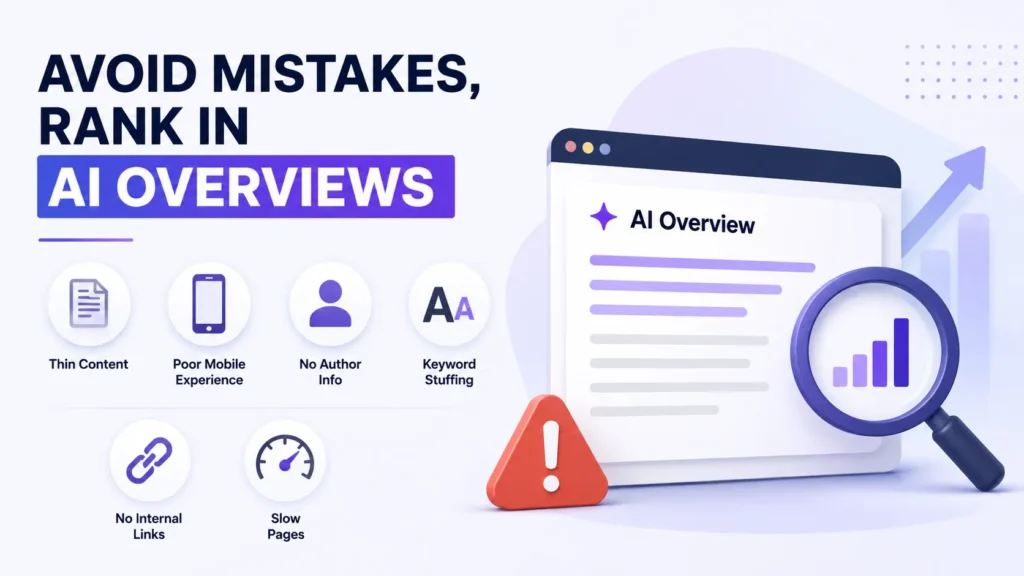
Avoid these mistakes at all costs:
- Writing thin, surface-level content — AI Overviews prefer depth and detail
- Ignoring mobile optimization — Poor mobile performance hurts your overall ranking signals
- Skipping author information — Anonymous content lacks E-E-A-T signals
- Using keyword stuffing — Aim for 1–2% keyword density, nothing more
- No internal linking — Connect your content clusters to pass authority between pages
- Neglecting Core Web Vitals — Slow pages rarely get cited
Fix these issues and your chances of ranking in AI Overviews improve dramatically.
Quick AI Overview Optimization Checklist
Use this before publishing every post:
- Focus keyword appears in title, H1, first paragraph, and at least two H2s
- Keyword density is between 1–2%
- Content answers the main question clearly within the first 100 words
- FAQPage schema is enabled via Rank Math
- Author bio with credentials is included
- At least one table or structured list is present
- Internal links to 2–3 related posts are added
- Content is at least 1,500 words
- All images have descriptive alt text
- Post has been updated within the last 6 months
Frequently Asked Questions
Q1. How long does it take to rank in AI Overviews?
There is no fixed timeline. Some well-optimized pages get cited within weeks. Others take several months. Consistency in publishing quality content speeds up the process significantly.
Q2. Do I need to be on page one of Google to appear in AI Overviews?
Not always. Google’s AI pulls from multiple sources, and some of those sources may not rank in the top 10 traditionally. However, strong authority and relevance are still key requirements.
Q3. Does Rank Math have specific features for AI Overview optimization?
Rank Math’s schema markup tools, content AI suggestions, and focus keyword analysis are all directly useful for AI Overview SEO. Use the FAQPage and HowTo schema options especially.
Q4. Can small blogs rank in AI Overviews?
Yes. Niche authority matters more than domain authority in many cases. A small, highly focused blog with deep topical coverage can outperform a large general site on specific queries.
Q5. Are AI Overviews shown for every search?
No. They appear most commonly for informational, question-based, and research-oriented searches. Commercial and transactional queries tend to show traditional results.
Q6. Does keyword density affect AI Overview rankings?
Indirectly, yes. Proper keyword usage (1–2% density) signals relevance without triggering spam filters. Over-stuffing keywords can hurt your overall page quality score.
Conclusion
Learning how to rank in AI overviews is one of the smartest investments you can make in your SEO strategy right now.
Google’s AI is rewarding content that is helpful, well-structured, authoritative, and up to date. If you focus on building E-E-A-T signals, writing clear answers, using schema markup, and developing topical authority — your chances of appearing in AI Overviews will grow steadily.
Start with one or two strategies from this guide. Apply them to your best-performing posts first. Track your results. Then scale what works.
The opportunity is real. Your content can show up at the very top of Google Search — even above the paid ads. All it takes is the right approach.
Now go optimize your content. Your spot in the AI Overviews is waiting.