What Is Domain Authority vs Domain Rating?
If you’ve been doing SEO for even a few weeks, you’ve probably come across two confusing terms — Domain Authority and Domain Rating. Both sound similar. Both deal with how “strong” a website is. But they are not the same thing.
Understanding what is domain authority vs domain rating is important because using the wrong metric to guide your SEO strategy can lead you in the wrong direction. In this guide, I’ll break down both metrics clearly, explain how they work, and tell you which one actually matters for your website.
What Is Domain Authority?
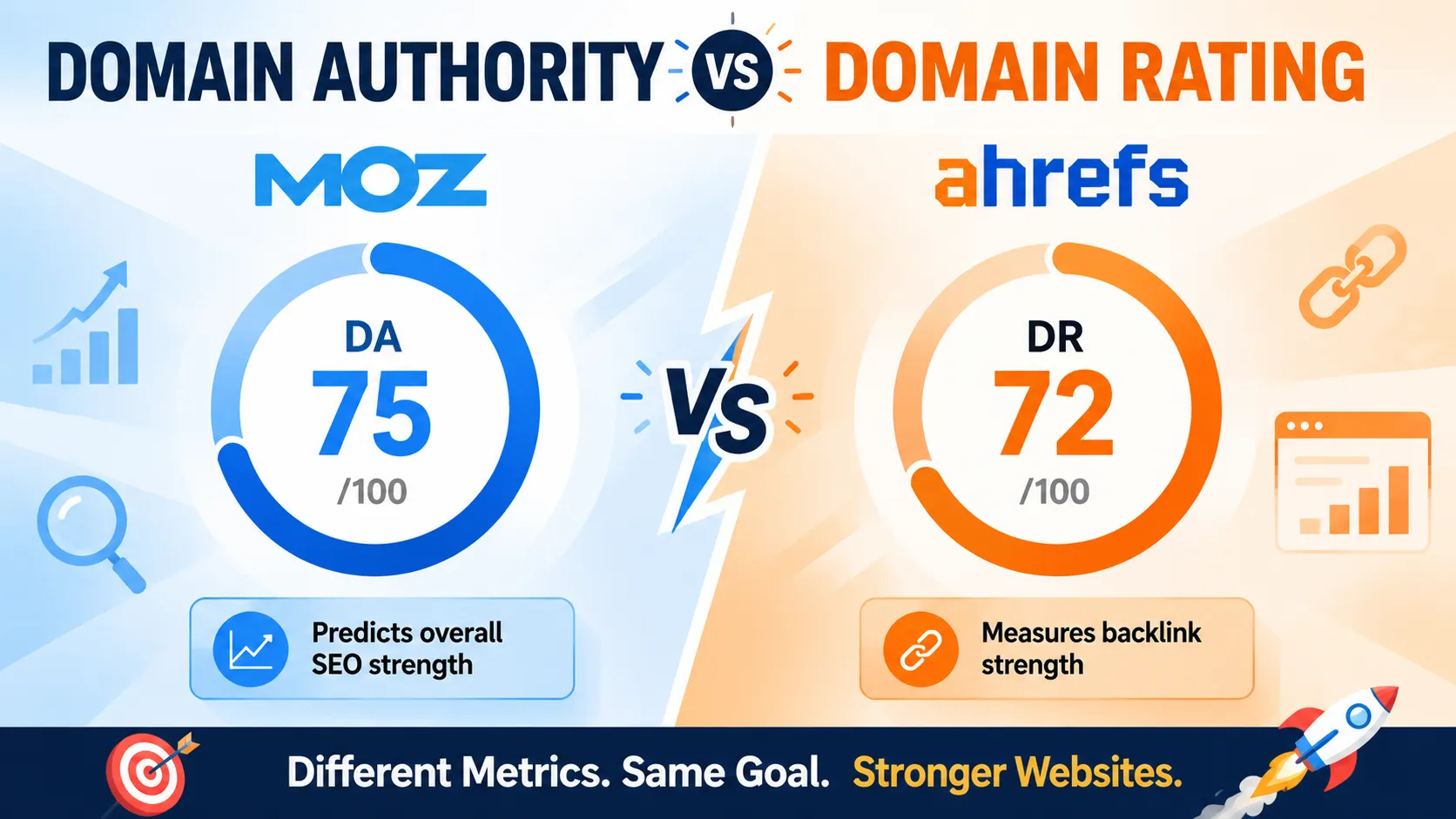
Domain Authority (DA) is a metric developed by Moz. It predicts how likely a website is to rank on search engine results pages (SERPs).
DA is measured on a scale from 1 to 100. The higher the score, the stronger the website’s ability to rank.
Moz calculates DA using dozens of factors, but the most important ones include:
- Total number of linking root domains (unique websites linking to you)
- Quality of inbound links
- MozRank and MozTrust scores
- Overall link profile health
One important thing to note — Domain Authority is a comparative metric, not an absolute one. A DA of 40 may be great in one niche but weak in another.
How Moz Calculates Domain Authority
Moz uses a machine learning model to calculate DA. The model compares your link profile against thousands of other websites and adjusts scores accordingly.
This also means that your DA can drop even if you haven’t lost any links. If other websites gain stronger links, your relative score can go down.
What Is Domain Rating?
Domain Rating (DR) is a metric developed by Ahrefs. It measures the strength of a website’s backlink profile on a scale from 0 to 100.
DR focuses almost entirely on backlinks — specifically, how many unique domains are linking to your site and how strong those linking domains are.
Ahrefs uses a logarithmic scale to calculate DR. This means:
- Going from DR 10 to DR 20 is relatively easy
- Going from DR 70 to DR 80 is significantly harder
DR does not directly consider on-page SEO, content quality, or technical SEO. It is purely a backlink-based metric.
How Ahrefs Calculates Domain Rating
Ahrefs calculates DR using the following logic:
- Count all unique domains linking to your website
- Weigh those domains by their own DR scores
- Factor in how many other sites each linking domain is linking to
- Apply a logarithmic adjustment to produce the final score
So if a DR 90 website links to 1,000 other websites, that link carries less weight than the same site linking to only 10 websites.
Domain Authority vs Domain Rating: Key Differences
Here is a quick side-by-side comparison so you can see the difference clearly:
| Feature | Domain Authority (DA) | Domain Rating (DR) |
|---|---|---|
| Developed by | Moz | Ahrefs |
| Scale | 1 – 100 | 0 – 100 |
| Primary focus | Link profile + multiple factors | Backlinks only |
| Update frequency | Monthly | Frequently (near real-time) |
| Logarithmic scale | Yes | Yes |
| Predicts Google rankings? | No (just a prediction tool) | No (just a comparison tool) |
| Free to check? | Yes (limited) | Yes (limited) |
| Best used for | Comparing overall site strength | Comparing backlink profiles |
Are Domain Authority and Domain Rating Google Ranking Factors?
This is one of the biggest misconceptions in SEO.
Neither DA nor DR is a Google ranking factor.
Google does not use Moz’s DA or Ahrefs’ DR to rank websites. Google has its own internal scoring system — PageRank — which is not publicly available.
DA and DR are third-party estimates created by SEO tools to help marketers understand and compare website strength. They are useful for research, but they are not signals Google uses directly.
That said, a website with a high DA or DR usually has a strong backlink profile. And a strong backlink profile does help you rank better on Google. So while the metrics themselves aren’t ranking factors, what they measure often is.
Which Metric Should You Trust More?
Both metrics have their place. Here’s a practical breakdown:
Use Domain Authority (DA) when:
- You are doing outreach and want a quick overview of a site’s authority
- You are comparing websites in Moz’s tool ecosystem
- You want a multi-factor measure of site strength
Use Domain Rating (DR) when:
- You are specifically evaluating the quality of a backlink
- You are doing a competitor backlink analysis
- You want a more up-to-date and granular backlink-specific measure
Many SEO professionals prefer DR because Ahrefs has one of the largest and most accurate backlink databases in the industry. But using both can give you a fuller picture.
Why Do DA and DR Sometimes Differ a Lot?
You may notice that the same website has a DA of 35 but a DR of 60, or vice versa. This happens for a few reasons:
- Different data sources: Moz and Ahrefs crawl different parts of the web and have different-sized link indexes
- Different algorithms: They weigh link factors differently
- Update frequency: Ahrefs updates more frequently than Moz
- Spam detection: Each tool handles spammy or toxic links differently
Neither one is “right” or “wrong.” They simply measure slightly different things.
How to Improve Your Domain Authority and Domain Rating
Since both metrics are heavily influenced by backlinks, improving one usually improves the other. Here are the most effective ways to build your scores:
1. Earn High-Quality Backlinks
Focus on getting links from websites with high DA and DR scores. One link from a DR 70 site is worth far more than 100 links from DR 5 sites.
2. Fix and Remove Toxic Links
Harmful or spammy backlinks can drag your scores down. Use Moz’s Link Explorer or Ahrefs’ Site Explorer to identify bad links and disavow them through Google Search Console.
3. Create Link-Worthy Content
Content that earns links naturally is the best long-term strategy. Think original research, detailed guides, free tools, and data-driven posts.
4. Audit Your Technical SEO
A solid technical foundation helps your site get crawled and indexed properly. If search engines can’t access your pages, your link equity doesn’t flow correctly. You can learn more about this by reading our guide on crawl budget in SEO — understanding this will help you make sure your most important pages are being crawled and indexed efficiently.
5. Do Regular Link Audits
Periodically check for broken links on your site. Broken links waste link equity and hurt user experience. Our detailed post on how to find broken links on your website walks you through the entire process step by step.
6. Build Internal Links Strategically
Internal linking helps distribute link equity across your website. It also helps search engines understand your site structure better.
What Is a Good Domain Authority Score?
There is no universal “good” score. It depends entirely on your niche and competition.
| DA Range | What It Generally Means |
|---|---|
| 1 – 20 | New or low-authority website |
| 21 – 40 | Moderate authority, growing site |
| 41 – 60 | Good authority, competitive in most niches |
| 61 – 80 | High authority, strong brand presence |
| 81 – 100 | Elite authority (Wikipedia, Forbes, etc.) |
The key is not to chase a specific number. Instead, focus on being stronger than your direct competitors. If everyone in your niche has DA between 25–35, getting to DA 45 puts you in a great position.
What Is a Good Domain Rating Score?
The same logic applies to DR. Here’s a general breakdown:
| DR Range | What It Generally Means |
|---|---|
| 0 – 20 | New site, very few backlinks |
| 21 – 40 | Building up, some quality links |
| 41 – 60 | Solid backlink profile |
| 61 – 80 | Strong profile, well-established site |
| 81 – 100 | Extremely powerful (BBC, Amazon, etc.) |
Again, compare yourself to your niche competitors rather than aiming for an arbitrary number.
Domain Authority vs Domain Rating in Competitive Analysis
When researching competitors or planning a link-building campaign, using both metrics together gives you a stronger picture.
For example, if you want to target a keyword and see that your competitors all have DA 50+ and DR 60+, you know you need to invest seriously in building authority before you can compete.
Similarly, when evaluating keyword difficulty, keeping an eye on the DA and DR of top-ranking pages helps you understand just how strong your competition actually is — and whether you have a realistic shot at ranking.
Common Mistakes People Make With These Metrics
Mistake 1: Treating DA or DR as a Google ranking factor They are not. Do not optimize for these scores directly.
Mistake 2: Only checking one metric Use both Moz and Ahrefs for a more complete picture. One tool might miss links the other catches.
Mistake 3: Obsessing over numbers instead of quality A website with DA 30 but highly relevant, niche-specific links can outrank a DA 60 site with random links.
Mistake 4: Panicking when scores drop Scores fluctuate. Algorithm updates, index refreshes, and changes in competitor link profiles all affect your score. A small drop is usually not a crisis.
Conclusion
So — what is domain authority vs domain rating? Here’s the simple answer:
- Domain Authority (DA) is Moz’s prediction score for how well your site can rank. It considers multiple link-related factors and updates monthly.
- Domain Rating (DR) is Ahrefs’ measure of your backlink profile strength. It is focused purely on links and updates more frequently.
Neither metric is a Google ranking factor. But both are valuable tools for understanding your site’s strength, comparing competitors, and planning your SEO strategy.
The best approach? Don’t obsess over either number. Instead, focus on building genuine, high-quality backlinks, producing excellent content, and fixing technical issues on your website. The scores will follow naturally.
Frequently Asked Questions
Q1: Is Domain Authority the same as Domain Rating?
No. Domain Authority is a metric created by Moz, while Domain Rating is created by Ahrefs. They use different algorithms, different data sources, and measure slightly different things — though both are heavily influenced by backlinks.
Q2: Which is more accurate — DA or DR?
Neither is “more accurate” because they measure different things. Many SEOs prefer DR because Ahrefs has a larger and more frequently updated backlink index. But DA is useful for a broader comparison that factors in multiple signals.
Q3: Does Google use Domain Authority or Domain Rating?
No. Google does not use either metric. These are third-party tools created by Moz and Ahrefs respectively. Google has its own internal system (PageRank) that is not publicly shared.
Q4: How often does Domain Authority update?
Moz updates Domain Authority approximately once a month. Domain Rating by Ahrefs is updated much more frequently — often within days of new links being discovered.
Q5: Can my DA or DR drop even if I haven’t lost links?
Yes. Because both metrics are calculated relative to other websites, your score can drop if competitors gain stronger backlinks — even if your own link profile remains unchanged.
Q6: What is a good Domain Authority for a new website?
A new website will typically start with a DA of 1. Getting to DA 20–30 within 6–12 months through consistent link-building is considered solid progress. Focus on your niche competitors rather than a specific number.
Q7: Should I buy backlinks to improve my DA or DR?
No. Buying backlinks violates Google’s Webmaster Guidelines and can result in manual penalties. Focus on earning links naturally through high-quality content, outreach, and digital PR.
Q8: How can I check my DA and DR for free?
You can check DA for free using Moz’s free Link Explorer tool (with limited searches per month). You can check DR for free using Ahrefs’ free website checker at ahrefs.com/website-authority-checker.