How to Use AI for Content Marketing: The Complete Guide 2026
Content marketing is harder than ever. Audiences demand more. Algorithms keep shifting. And your team still has the same 24 hours it always did.
That is exactly why knowing how to use AI for content marketing has become a must-have skill — not a nice-to-have.
AI is not here to replace your creative team. It is here to remove the repetitive, time-consuming parts of the job. So your team can focus on strategy, storytelling, and real human connection.
In this guide, you will get a clear, step-by-step breakdown of using AI to plan, create, optimize, and distribute content — the right way.
Quick Stat: A 2025 HubSpot report found that marketers using AI tools save an average of 5+ hours per week on content tasks. That is over 260 hours per year, per person.
What Is AI Content Marketing?
AI content marketing means using artificial intelligence tools to plan, create, optimize, and distribute your content.
It is not about pressing a button and letting a robot do everything. It is about using smart tools to work faster, make better decisions, and scale your content output without burning out your team.
Think of AI as your most productive team member — one that never sleeps, never gets writer’s block, and can process data faster than any human.
Key Benefits of Using AI for Content Marketing
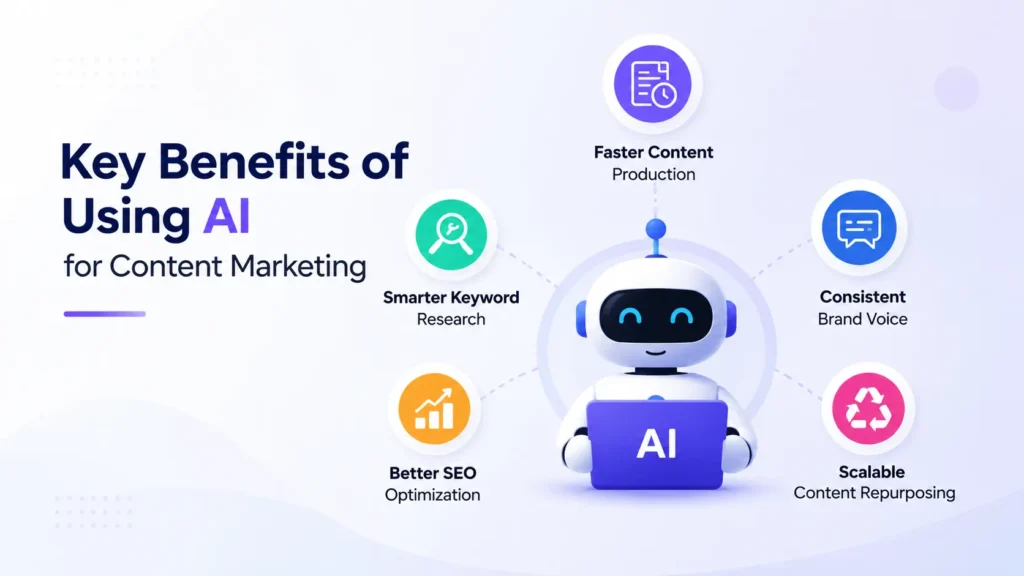
Before diving into the how, it helps to understand the why. Here is what AI actually does for your content workflow.
| Benefit | What It Means for You | Impact |
|---|---|---|
| Faster Content Production | Draft articles, emails, and posts in minutes | Very High |
| Smarter Keyword Research | Find high-value topics and long-tail keywords quickly | Very High |
| Better SEO Optimization | Real-time suggestions for headings, meta, and readability | High |
| Consistent Brand Voice | Train AI on your style to keep tone consistent | High |
| Scalable Repurposing | Turn one blog post into 10 pieces of content | Very High |
| Lower Content Costs | Do more with a smaller team | High |
The results speak for themselves. Marketers who use AI strategically are not just saving time — they are producing better content, more consistently.
How to Use AI for Content Marketing: Step-by-Step
This is the section most guides skip — the actual workflow. Here is a practical, repeatable process you can start using today.
Step 1: Use AI for Keyword and Topic Research
Every great piece of content starts with the right topic. AI tools make this phase significantly faster and more data-driven.
Use AI-powered SEO tools like Semrush, Ahrefs, or even a simple ChatGPT prompt to generate topic clusters around your main keyword. Ask the AI to surface questions your audience is already searching for.
Try this prompt: “Give me 15 long-tail keyword ideas around [your topic] for a beginner audience. Focus on informational intent and low competition.”
This alone can save you hours of manual research every single week.
Step 2: Build a Content Strategy and Calendar
Random posting does not build authority. AI can help you map out a structured content calendar that aligns with your business goals.
Feed your target audience details, niche, and goals into a tool like Claude or ChatGPT. Ask it to create a 30-day or 90-day content plan with titles, formats, and publishing frequency.
This removes the guesswork. Every piece of content will have a clear purpose — whether that is driving traffic, generating leads, or building brand awareness.
Step 3: Create High-Quality Content Drafts
This is where most marketers start — and where they often go wrong. AI should write with you, not instead of you.
Use AI to generate a first draft based on your outline, focus keyword, and target audience. Then revise it with your own voice, real-world examples, and unique insights.
That human layer is what makes content rank and resonate. Do not skip it.
Important Rule: Never publish raw AI output. Add your own experience, examples, and perspective. Google rewards E-E-A-T — Experience, Expertise, Authoritativeness, and Trustworthiness.
Step 4: Optimize Your Content for SEO
After drafting, use AI-powered tools to sharpen your SEO. This includes checking keyword placement, improving readability, and writing compelling meta descriptions.
If you use the Rank Math SEO plugin, pair it with an AI writing assistant. Rank Math shows you what is missing — AI helps you fill those gaps fast.
Key things to check:
- Focus keyword in the first 10% of content
- Keyword included in at least one H2 or H3 heading
- Meta description under 160 characters
- At least one internal link and one external link
- Image alt text using a keyword variation
Step 5: Repurpose Content Across Channels
One of the biggest advantages of knowing how to use AI for content marketing is the ability to repurpose content at speed.
Take a finished blog post and ask AI to turn it into:
- A Twitter/X thread with 8–10 tweets
- A LinkedIn carousel with key takeaways
- A short YouTube script or video summary
- A weekly newsletter section
- An Instagram caption with relevant hashtags
This multiplies the value of every piece you create — without extra research or creative effort.
Step 6: Analyze, Improve, and Repeat
AI is also valuable after you hit publish. Use AI analytics tools to understand which content is working, which topics are gaining traction, and where your funnel is leaking.
Feed your Google Analytics or Search Console data into an AI model and ask it to find patterns. It will spot opportunities faster than any manual review ever could.
Best AI Tools for Content Marketers in 2026
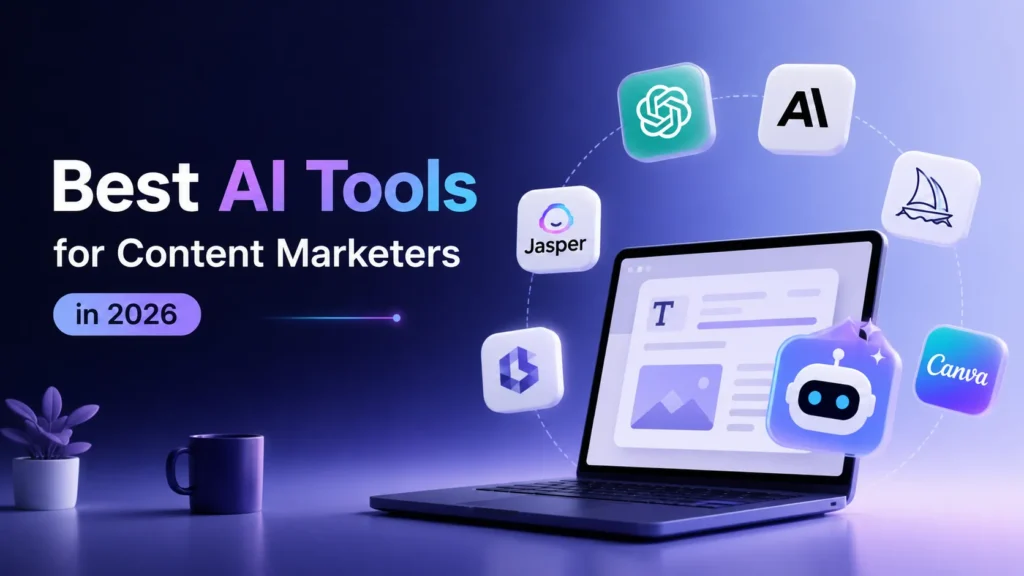
Choosing the right tools matters. Here is a breakdown of the best AI tools for each stage of your content marketing workflow.
| Tool | Best For | Key Feature | Pricing |
|---|---|---|---|
| Claude (Anthropic) | Long-form writing and research | Deep reasoning, nuanced tone | Free / Pro |
| ChatGPT (OpenAI) | Drafting and brainstorming | Versatile, large plugin ecosystem | Free / Plus |
| Surfer SEO | SEO content optimization | Real-time SERP analysis | From $89/mo |
| Jasper AI | Marketing copy and campaigns | Brand voice training | From $49/mo |
| Semrush AI | Keyword and topic research | Topic cluster builder | From $139/mo |
| Descript | Video and podcast content | AI transcription and editing | Free / Pro |
| Canva AI | Visual content creation | AI image generation and design | Free / Pro |
You do not need all of these. Start with one or two tools and build from there as your workflow matures.
AI Content Marketing Strategy Tips That Actually Work
Using AI tools is one thing. Using them strategically is another. Here are the tips that separate good content marketers from the ones dominating search results.
Train AI on Your Brand Voice Give the AI your existing top-performing content and explain your audience, tone, and style. The more context you provide, the more on-brand the output will be.
Use AI for Ideation, Humans for Storytelling AI is brilliant at generating ideas and structures. But personal stories, case studies, and real opinions are what keep readers engaged and build the trust that no AI can replicate.
Build a Prompt Library Create a saved library of high-performing prompts for tasks you repeat often — blog introductions, social captions, email subject lines. This saves hours every week.
Set a Human Editing Rule Every AI-generated piece must be reviewed and edited by a human before publishing. This protects your brand and ensures factual accuracy at all times.
Track What AI Content Performs Best Not all AI-assisted content will perform equally. Review your metrics monthly and double down on the formats and topics that drive real results.
Common Mistakes to Avoid When Using AI for Content Marketing
AI can do amazing things — but it can lead you the wrong way if you are not careful. Watch out for these common mistakes.
| Mistake | Why It Hurts | What to Do Instead |
|---|---|---|
| Publishing without editing | Raw AI content is often generic and surface-level | Always add personal insight and check for accuracy |
| Ignoring E-E-A-T signals | Google downgrades thin, experience-free content | Include author bios, real examples, and citations |
| Over-stuffing keywords | Keyword stuffing leads to Google penalties | Keep keyword density between 1–2% naturally |
| Not fact-checking AI claims | AI can hallucinate statistics and sources | Always verify data from primary sources |
| Skipping a content strategy | Random AI content does not build topical authority | Plan topic clusters around your core keywords |
Avoiding these mistakes will save you from a lot of wasted effort — and potential ranking drops.
Frequently Asked Questions
Can beginners learn how to use AI for content marketing easily?
Yes, absolutely. Most AI writing tools have a simple, intuitive interface. You do not need any technical background. Start with free tools like Claude or ChatGPT, practice writing clear prompts, and gradually build your workflow around them.
Does Google penalize AI-generated content?
No. Google does not penalize content for being AI-generated. It penalizes low-quality, unhelpful, and spammy content — regardless of who wrote it. Well-researched, human-reviewed AI content can and does rank on page one.
What is the best AI tool for content marketing in 2026?
There is no single best tool — it depends on your needs. For long-form SEO content, Claude and ChatGPT are excellent. For SEO optimization, Surfer SEO is a top pick. For social media copy, Jasper works well. Most marketers end up using two or three tools together.
How much time can AI actually save in content marketing?
Depending on your workflow, AI can save between 30–60% of your content creation time. Research, outlining, drafting, and repurposing can all be done in a fraction of the usual time.
Is AI content marketing suitable for small businesses?
Yes — small businesses benefit the most. AI levels the playing field by allowing a one-person team to produce the volume and quality of content that once required an entire department.
How do I maintain my brand voice when using AI?
Give the AI clear style guidelines in every prompt. Describe your tone, your audience, and share two or three examples of your existing content. The more context you provide, the more aligned the output will be.
Conclusion
Knowing how to use AI for content marketing is no longer optional — it is a genuine competitive advantage.
The marketers who win in 2026 are not the ones who avoid AI out of fear. They are the ones who embrace it intelligently — using it to work faster, think bigger, and create content that genuinely helps their audience.
Start small. Pick one AI tool. Apply it to one part of your workflow — keyword research, drafting, or repurposing. Once you see the results, you will naturally expand from there.
The goal has never changed: create content that solves real problems for real people. AI just makes that goal a whole lot more achievable.